
Seven years ago, I visited a rural community that had been begging for better access to connectivity for years. The big telcos had looked at the area, done the math on how many customers they could sign up, and walked away. The community was told they’d need to raise a few hundred thousand dollars themselves before the telcos would even consider building a new cell tower near them. So I decided to build my own.
That’s how WombatNET was born. Not with government funding or venture capital, but because the major providers had decided certain communities simply weren’t worth their time. We filled that gap, putting up towers in Mangaroa, Whitemans Valley, Wainuiomata, and across the Kāpiti Coast. We became the local operator people could trust to actually show up.
The market has shifted dramatically since then. Starlink arrived, Amazon’s Leo is coming, and suddenly, rural connectivity looks like a growth market worth competing for. The domestic providers who’ve been serving these communities for years are being priced out by foreign satellite companies with billions in backing. Last October, Evolution Networks in the Bay of Plenty collapsed (paywalled). Other regional operators are under pressure. The Commerce Commission’s own report warns that Starlink could easily become the dominant or monopoly supplier nationwide.
And yet somehow, this isn’t news.
Peaches Get More Attention Than Telecommunications
I saw on the news last night that the New Zealand government found Chinese peaches are being ‘dumped’ into the country, selling for less here than in their home market. MBIE investigated after a complaint from Watties last year, and the Commerce Minister has now proposed anti-dumping duties of 17.78 per cent. The logic is straightforward: market dumping distorts competition and harms local producers.
But here’s what I don’t understand. Peaches warrant a full government investigation, proposed duties, and national news coverage. Meanwhile, an entire industry providing critical infrastructure to rural communities is being priced out by foreign providers that charge New Zealand customers near the bottom of their global pricing range, while their home base, the United States, sits near the top, and nobody seems to think that’s worth examining.
Maybe if they’re dumping in many other countries as well, that makes it acceptable here? I’m genuinely asking, because the logic escapes me.
What I Told Parliament
In January, I presented to Parliament’s Economic Development, Science and Innovation Committee on the Telecommunications Amendment Bill. The bill itself dealt with, among other things, changes to how the Telecommunications Development Levy is collected and how fibre companies access shared property for installations. We supported both provisions.
But I also put on the record a problem that I don’t think gets discussed enough. Among other system issues, domestic rural connectivity providers face structural barriers to capital access that foreign, billionaire-backed satellite providers don’t. Banks won’t lend against rural telecommunications infrastructure because they classify it as illiquid. Towers on leased land, short-lifetime radio equipment, and spectrum licences – none of it fits the traditional lending criteria. So while large telcos can borrow against urban assets to fund rural builds, many regional operators are entirely locked out of the capital markets.
This isn’t about a lack of technical capability or demand for our services. The technology to compete exists. Current-gen wireless technologies can easily deliver speeds exceeding 1 Gbps. Customers want it. What doesn’t exist, is a level playing field for accessing the capital needed to deploy that technology at scale and compete effectively.
When a regional provider exits, nothing replaces it. Towers get decommissioned. Spectrum sits idle. The local engineers who kept things running move on. For many rural communities, that’s not just a change of ISP. That’s the end of same-day in-person support, the end of price competition, and the end of any earth-based alternative when an offshore provider raises prices or changes terms. Rural communities know better than anyone what it means to have no options. This is how that happens again.
Why This Matters
Low Earth Orbit (LEO) Satellite is an exciting technology. It serves many customers well, particularly in genuinely remote locations where terrestrial infrastructure will never be economic. But a telecommunications market served exclusively by foreign satellite providers carries risks that don’t exist when there’s domestic terrestrial competition.
Local networks provide infrastructure resilience during emergencies. They provide local employment. They provide regulatory leverage. When copper (the traditional ‘fall-back’) is being actively withdrawn based on the official assumption that satellite and fixed wireless offer sufficient competition, it matters whether the “fixed wireless” part of that equation still exists in five years.
Just because revolutionary new technology has arrived doesn’t mean all the old problems disappear. In fact, it creates new ones. If domestic providers continue to exit because they can’t access capital, while foreign providers price aggressively to capture market share, rural New Zealand risks becoming entirely dependent on offshore satellite companies with no local presence and limited regulatory and legal accountability.
ISPANZ, the Internet Service Providers Association, sent a follow-up letter to the committee after my submission, specifically endorsing my concerns about capital access and infrastructure resilience. They encouraged the committee to find a way to give effect to my recommendations. This matters because it’s not just one operator complaining – it’s an industry-wide structural problem.
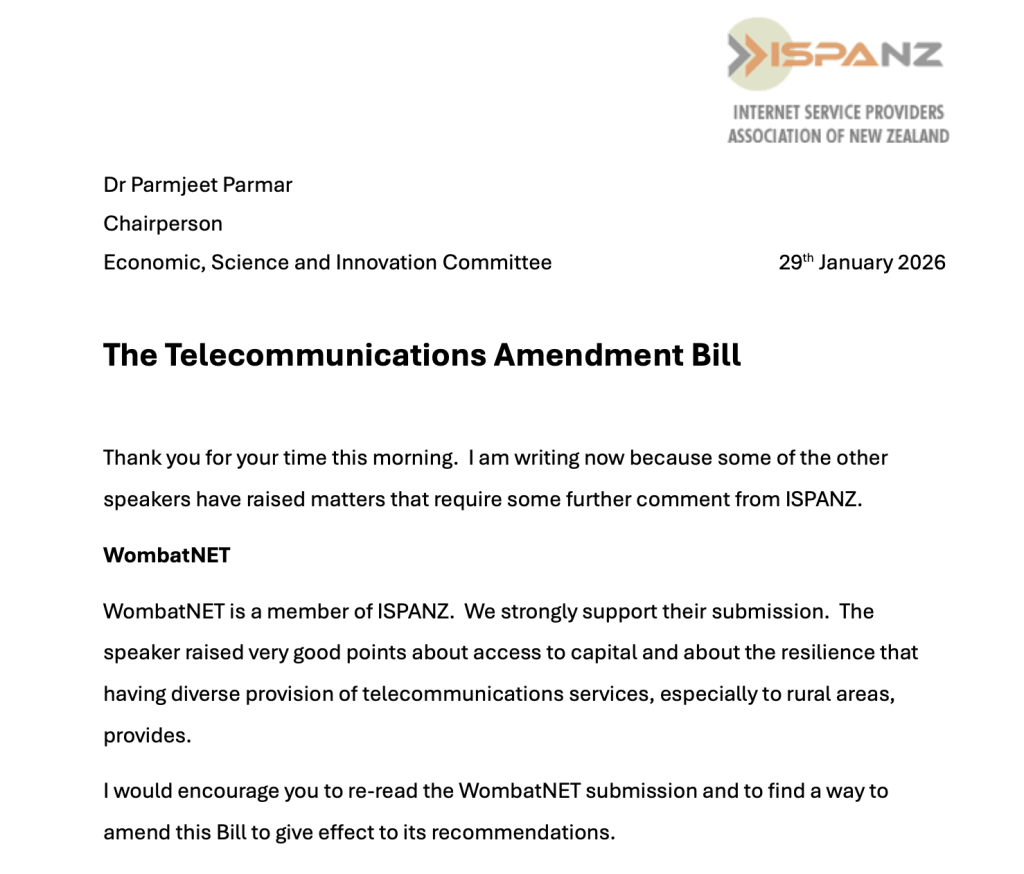
ISPANZ’s follow-up letter to the committee, endorsing WombatNET’s submission and encouraging action on capital access and infrastructure resilience.
The Bigger Picture
I’m not opposed to competition. Competition plays a crucial role in fostering innovation and creating exciting new opportunities. What I am opposed to, rather, is a policy environment where peaches warrant Government investigations and national news coverage, but an entire domestic industry that provides critical infrastructure to rural communities can collapse in silence while offshore competitors price markedly below their home-market rates, and nobody thinks that’s worth examining.
Rural connectivity isn’t a technical problem anymore. It’s a policy problem. And if we don’t address it, the communities that were left abandoned by big telcos seven years ago will find themselves in the same position again, except this time there won’t be a domestic operator left to fill that gap. Will we risk our rural futures on orbiting strangers?
You can watch my full oral parliamentary select committee submission below.
Whether this leads to any policy change remains to be seen. But it’s on the record now, and that’s where change has to start.
You can also read my full written submission here.
Want to discuss connectivity challenges or policy issues affecting rural New Zealand? Connect with me on LinkedIn.
